Forensic video expertise · report v2
IMG_5887 · secondary-capture airborne target
Protocol v2 · evidence-led identification with explicit unknowns
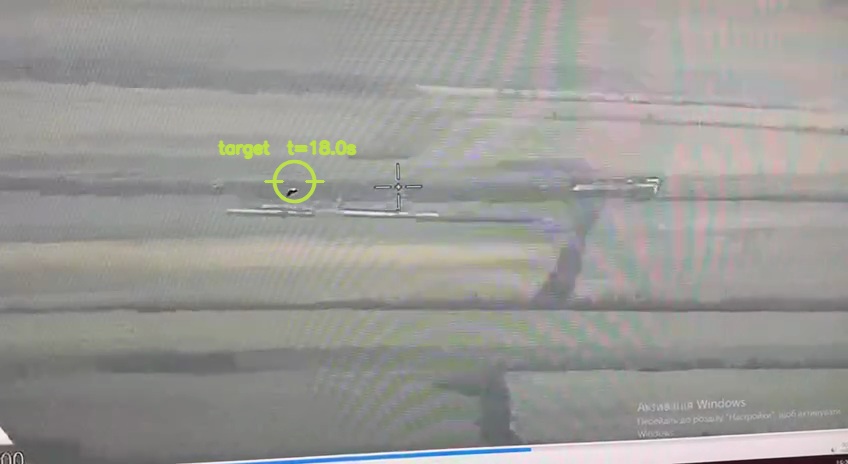
01 / Finding
Likely bird; confirmation requires the original
Identification status: likely known, with more data needed. A bird is the leading class because the target follows a persistent independent screen path and repeatedly cycles between compact and curved, extended, wing-like profiles in separated intervals. Secondary-camera glare, a dead or stuck display pixel, and moiré do not reproduce that combined behavior. The conclusion remains class-level rather than confirmed: the original displayed file, source-camera metadata, witness account, event time, location, and independent sensors were not supplied. Upstream lens artifacts, staging, and editing therefore cannot be audited conclusively, and no physical-performance claim is supportable.
02 / Executive summary
What the evidence supports
The delivered 24.333-second MP4 is a phone recording of a computer monitor, not the original aerial acquisition. One compact target is confirmed from 4.0 through 24.0 seconds and spans about 5–14 delivered pixels. Ten-frame-per-second crop sequences repeatedly show compact and curved/extended states compatible with wing motion; this temporal pattern is the strongest positive evidence for bird. File hash, stream facts, target persistence, screen-coordinate track, crop method, and near-silent audio are reproducible. Range, altitude, field of view, angular rate, physical size, speed, acceleration, turn radius, true color, and luminosity are not recoverable. Because event time and location are unverified, astronomy, weather, satellite, ADS-B, and radar correlations were not run. Information completeness is 42/100: adequate for a provisional class comparison, inadequate for source authentication or physical performance.
Positive morphology supports the leading class. Missing witness, calibration, sensor, or source-history data remain unknown and cannot be counted as evidence for or against a class.
03 / Protocol coverage
What was known, missing, or not applicable
The v2 protocol keeps absent, unknown, not measured, and not applicable states separate. An absent signature only counts when this evidence could have detected it.
Astronomy, weather, satellite, ADS-B, radar, and local-activity checks were not run because event time and location are not verified. A database non-match without those inputs would be misleading.
04 / Assurance
Three scores answer three different questions
Evidence fit compares hypotheses; information completeness measures discriminator coverage; physical readiness asks whether calibrated world quantities can be recovered. None is a probability.
Secondary display recording; no original file or documented acquisition chain.
No source FOV, zoom, range, altitude, telemetry, or ground control.
Only about 5–14 delivered pixels across, with two capture/compression generations.
730-frame CFR stream and a target confirmed continuously over at least 20 seconds.
Hash and stream metadata are repeatable; device, GPS, and upstream history are absent.
05 / Timeline
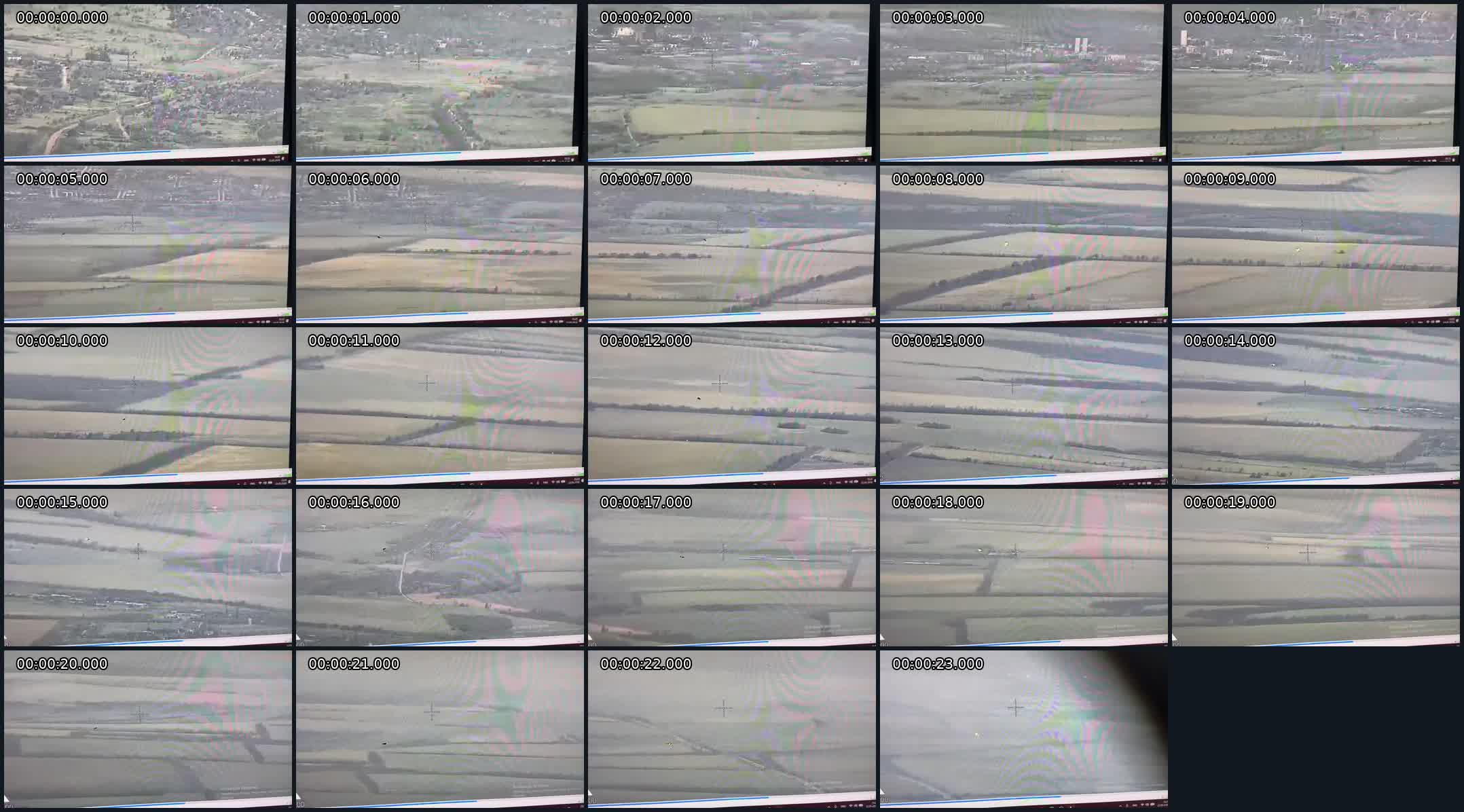
One continuous tracking view
The landscape pans beneath an approximately fixed reticle. The target is small at this scale; annotated and centred evidence follows below.
06 / Morphology
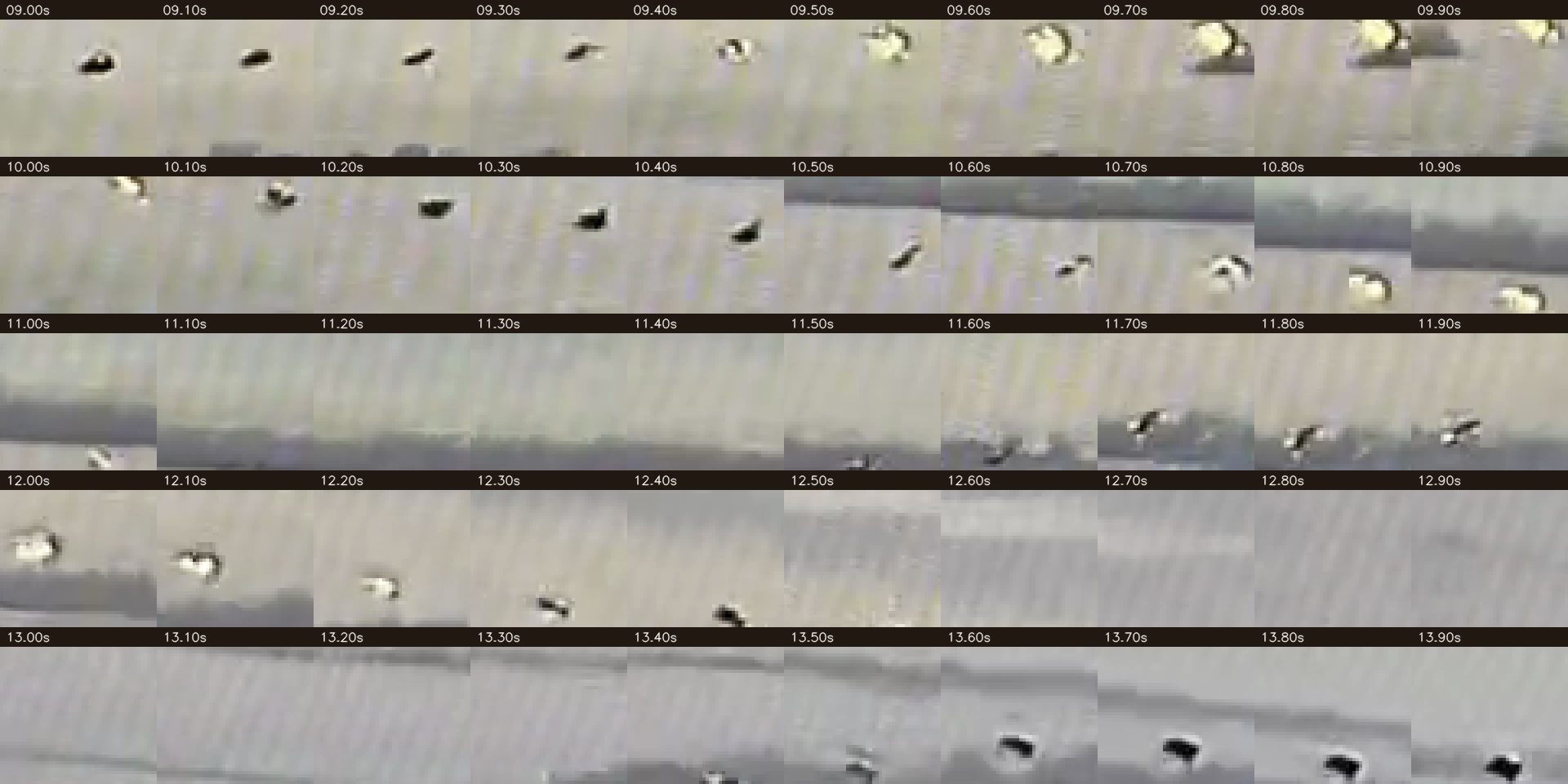
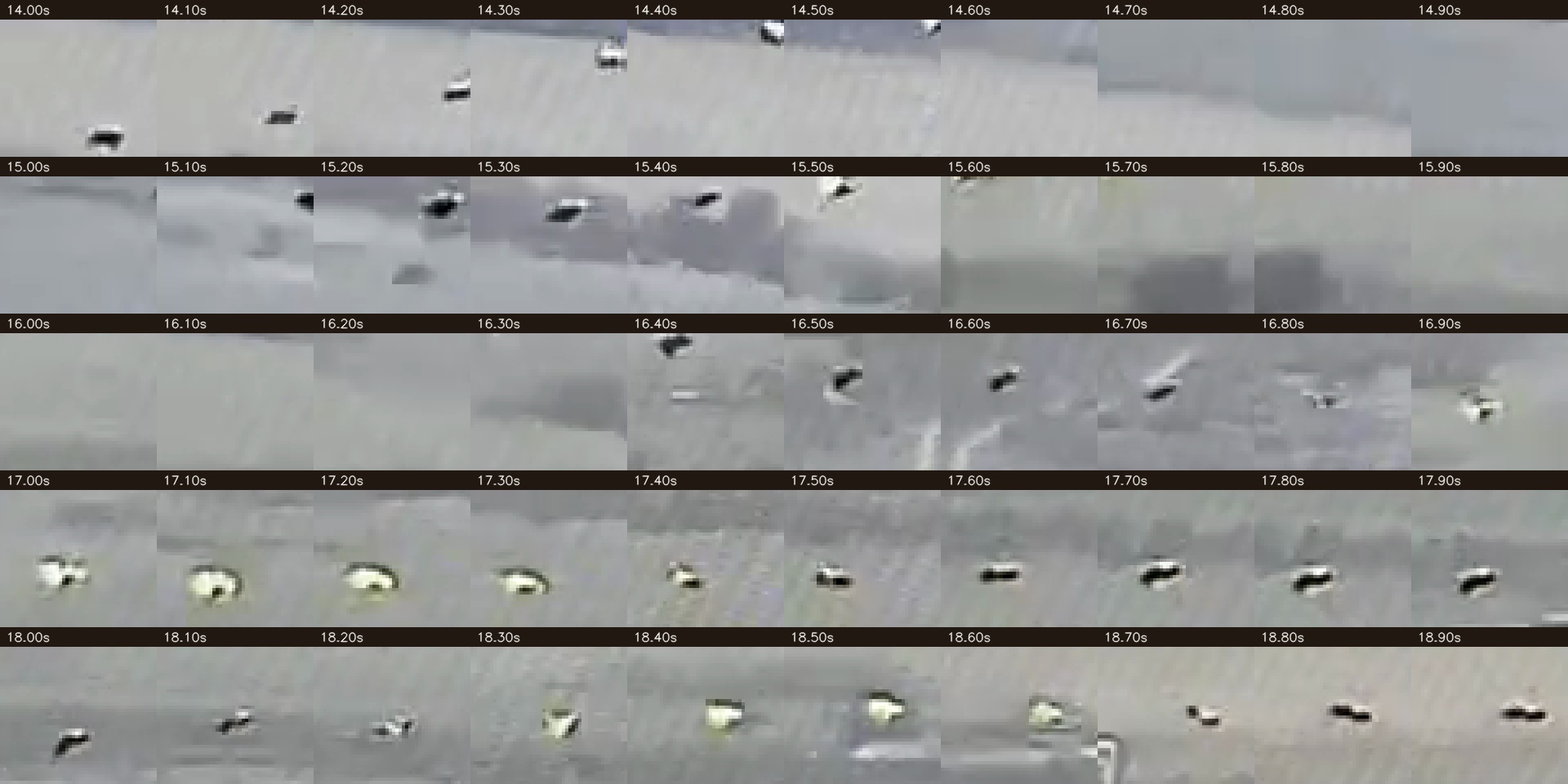
A recurring wing-like profile cycle
The sequence moves from curved/extended through compact/elongated states. Similar cycles recur in separated parts of the clip, which is stronger evidence than any single frame.

Repeated across more than one clean interval.
The encoded target is too small and contaminated.
Contrast, specular reflection, and display capture can invert polarity.
Open longer 10 fps crop grids
07 / Track
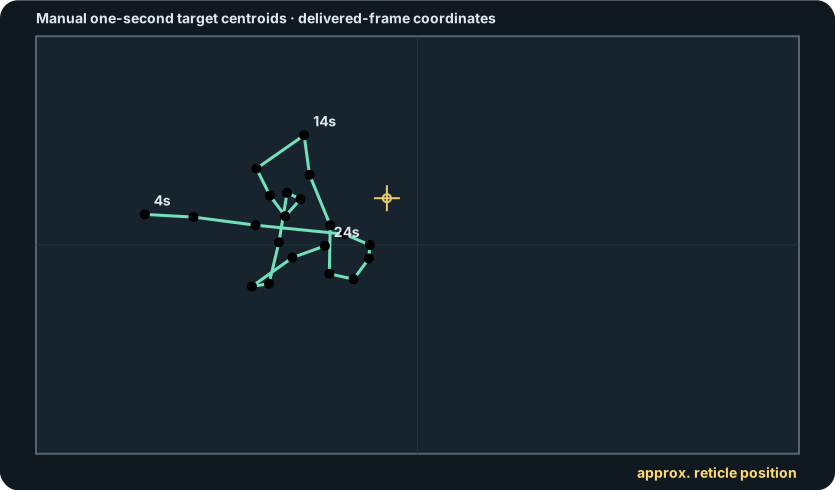
Screen trajectory, not world trajectory
Twenty-one one-second centroids preserve a comparison signature for future cases. Source-camera pan and zoom are intentionally not subtracted.
08 / Measurements
Accepted, bounded, unavailable, and rejected
A high confidence on “not estimable” means the missing inputs are known to block the claim.
| Quantity | Result | Status | Grade | Assurance | Method / limit |
|---|---|---|---|---|---|
| Source SHA-256 | b62d80e1…e2f12 | Measured | A | 99/100 | SHA-256 over the untouched supplied file. The abbreviated display value is backed by the full hash in provenance. |
| Encoded duration | 24.333000 s | Measured | A | 99/100 | FFprobe format/video-stream duration. Dates the delivered secondary recording only. |
| Frame geometry | 848 × 464 | Measured | A | 99/100 | Decoded H.264 stream geometry. Not the resolution of the unavailable displayed source. |
| Frame rate / count | 30.000 fps · 730 frames | Measured | A | 99/100 | FFprobe average/rate fields and decoded count. Display refresh interaction can still alter sampled appearance. |
| Confirmed target persistence | ≥ 20.0 | Bounded | B | 90/100 | Manual confirmation at one-second anchors from 4.0 to 24.0 seconds. The target may also be present in earlier cluttered frames. |
| Apparent target width | 5.000000–14.000000 delivered px | Bounded | C | 65/100 | Manual compact/extended profile bounds in clean crop intervals. Blur, ringing, moiré, and wing phase change the thresholded edge. |
| Frame-width occupancy | 0.600000–1.700000 % | Derived | C | 65/100 | Apparent width bounds divided by 848 encoded pixels. Does not equal angular size. |
| One-second anchor path | 868.470000 delivered px | Derived | C | 72/100 | Sum of Euclidean steps between 21 one-second manual centroids. Includes camera/source pan and is not a ground-relative trajectory. |
| Median one-second screen step | 41.340000 px/s | Derived | C | 70/100 | Median displacement between adjacent one-second manual centroids. Must not be converted to m/s without calibrated FOV/range. |
| Audio level | mean −61.1 · peak −39.6 | Measured | A | 98/100 | FFmpeg volumedetect over the complete AAC stream. No original displayed-source audio provenance. |
| Background-compensated pixel speed | 57–5,018 (unstable; rejected) | Rejected result | E | 99/100 | Per-second ORB/homography registration trial. Low/variable inlier fractions, large pan/zoom, parallax, moiré, and a 5,018 px/s outlier invalidate the result. |
| Physical speed | Not estimable | Not estimable | E | 99/100 | Photogrammetric observability check. Requires original FOV/zoom, range or altitude, geometry, and stable ground registration. |
| Physical size | Not estimable | Not estimable | E | 99/100 | Photogrammetric observability check. Pixel span without range and angular calibration has infinitely many size/distance solutions. |
| Angular size | Not estimable | Not estimable | E | 99/100 | Calibration observability check. Monitor scaling and source camera FOV/zoom are unknown. |
| Slant range / altitude | Not estimable | Not estimable | E | 99/100 | Geometric observability audit. No triangulation, radar, telemetry, calibrated horizon, or known-size reference. |
| Angular velocity | Not estimable | Not estimable | E | 99/100 | Angular calibration observability audit. Unknown source FOV/zoom and invalid background stabilization block conversion from pixels. |
| Acceleration / turn radius | Not estimable | Not estimable | E | 99/100 | Dynamics observability audit. Requires a valid world trajectory, timestamps, range, and camera-motion solution. |
| True color / luminosity | Not estimable | Not estimable | E | 98/100 | Radiometric observability audit. Unknown exposure and two processing/display stages prevent calibrated radiometry. |
| World-relative trajectory | Not estimable | Not estimable | E | 99/100 | Coordinate-transform audit. Screen centroids cannot be separated reliably from source pan, zoom, parallax, and display recapture. |
09 / Observation ledger
Every material claim carries its basis
The supplied MP4 is a secondary monitor capture
Monitor bezel, player chrome, Windows UI/watermark, keystone, moiré, and a fixed reticle are visible. These identify the delivered file as a second acquisition stage, not the source-camera recording.
Method and limitations
MethodFull-frame visual inspection plus container metadata review.
LimitThe number and processing history of upstream generations remain unknown.
Elevated daylight view over a rural/edge-of-town landscape
The displayed footage pans across patchwork fields, tree lines, roads, low-rise settlement, water or flooded/quarry features, and industrial structures. Visibility is hazy and contrast is low.
Method and limitations
MethodOne-second full-frame timeline review.
LimitNo unique landmark or metadata establishes a location.
One coherent target persists for at least 20 seconds
The same compact target is manually confirmed from 4.0 through 24.0 seconds. It moves relative to the approximately fixed monitor reticle and does not remain locked to one delivered-frame coordinate.
Method and limitations
MethodFull-frame review and one-second centroid annotations.
LimitThis establishes screen-relative persistence, not a world trajectory.
Recurring compact-to-extended profile change
Across multiple intervals the image alternates between a compact oval/elongated form and a broader curved or U-like extended form. The repeated sequence is consistent with changing wing position.
Method and limitations
Method10 fps target-centred crops, nearest-neighbour enlargement only.
LimitThe target is only a few pixels wide; moiré, display refresh, and compression affect exact contour and prevent species identification.
Polarity changes with profile/background
The target appears dark in some frames and bright or rim-bright in others. This is compatible with changing reflectance, background contrast, and re-filming artifacts; it is not evidence of self-luminosity.
Method and limitations
MethodCrop-sequence luminance comparison.
LimitTrue target colour and radiance are not recoverable.
Rigid structure, lights, and trail are indeterminate
No stable rigid outline, rotor, fuselage, flashing point light, exhaust, contrail, or wake is resolved at the delivered scale. The target is too under-sampled for those non-detections to exclude a small aircraft or drone by themselves.
Method and limitations
MethodFrame and crop-sequence review.
LimitDetection capability is inadequate; this is not evidence of true absence.
Secondary-camera glare and display defects are strongly disfavoured
A phone-lens ghost, dead/stuck pixel, monitor dirt, or display defect should remain tied to second-camera or display geometry. The target moves hundreds of delivered pixels relative to the reticle and changes profile while broad moiré bands follow screen behavior.
Method and limitations
MethodCoordinate-lock and morphology-behaviour tests.
LimitThis test does not exclude an artifact already embedded in the unavailable upstream source.
Compression affects detail but does not create the whole track
Block edges, ringing, moiré, and contrast halos modify the target silhouette. They cannot alone explain a coherent 20-second trajectory with recurring extended/compact phases.
Method and limitations
MethodArtifact morphology compared with target persistence.
LimitFine contour and colour claims remain unsafe.
Audio track is near-silent and non-diagnostic
The AAC stereo track measures approximately −61.1 dBFS mean and −39.6 dBFS peak. No useful event-correlated acoustic signature is visible.
Method and limitations
MethodFFmpeg volumedetect across the full audio stream.
LimitThe displayed source audio may have been muted before re-recording.
Delivered stream is continuous, but upstream editing is unknown
The container reports one 24.333-second progressive H.264 stream at 30 fps with 730 frames and one near-silent AAC stream. Visual review does not reveal a hard internal cut.
Method and limitations
MethodFFprobe stream decode plus contact-sheet continuity review.
LimitA continuous export does not prove the displayed source was unedited.
No witness account or recorder questionnaire was supplied
The case contains the MP4 and derived analysis assets but no free narrative, recorder identity, observation geometry, device handling history, or contemporaneous notes.
Method and limitations
MethodCase-evidence inventory against the v2 intake checklist.
LimitThis records absence from the submission, not proof that no witness existed.
Event time and location are not established
The container tag belongs to the secondary phone recording. There is no GPS, verified landmark, timezone, or source-camera timestamp for the displayed event.
Method and limitations
MethodContainer metadata, visual landmark, and case-record review.
LimitAstronomy, weather, satellite, ADS-B, radar, and local-activity correlations would be invalid without these inputs.
Only one secondary visible-light modality is available
No independent original video, thermal, radar, RF, calibrated acoustic, telemetry, or environmental sensor record was supplied.
Method and limitations
MethodEvidence inventory by modality.
LimitNo negative inference about radar, heat, RF, or sound is permitted.
Apparent maneuvers remain screen-relative
The annotated path combines target motion, source-camera motion, display transform, and secondary-camera geometry. No interval supports a calibrated acceleration, hover, turn radius, or world path.
Method and limitations
MethodCoordinate-system and observability audit.
LimitScreen movement remains useful for continuity and artifact lock tests.
Upstream optical artifacts remain indeterminate
The delivered target does not behave like a secondary-camera lens ghost, but the original optical center, bright-source geometry, focus, exposure, sensor coordinates, and lens state are unavailable.
Method and limitations
MethodTwo-stage imaging-pipeline artifact routing.
LimitOriginal frames and device/lens reconstruction are required for a conclusive upstream flare, defocus, dust, or near-camera test.
No reliable upstream manipulation verdict is possible
The delivered H.264 stream is internally continuous at report scale and no obvious hard cut is observed. That authenticates neither the content shown on the monitor nor its earlier processing history.
Method and limitations
MethodSource-generation, metadata, continuity, and spatial/temporal consistency review; no stand-alone ELA verdict.
LimitThe upstream file, native metadata/noise, source history, and independent copies are missing.
10 / Alternatives
Competing explanations tested
Fit and information completeness are separate. A hypothesis may fit the few available facts while most of its decisive tests remain unavailable.
Bird
Repeated compact-to-curved/extended profile cycling across separated intervals, together with persistent scene motion and changing reflectance, is most consistent with a bird at low spatial sampling.
Evidence test
SupportsRepeated wing-like morphology over separated intervals; no stable rigid geometry; no resolved light or trail.
ConflictsThe source is secondary and under-sampled; species, range, focus class, native wing contour, and original cadence remain unknown.
Best next testObtain the original source and inspect native-resolution consecutive frames.
Conventional drone or small aircraft
A small aircraft can traverse the scene but should retain a more stable rigid profile.
Evidence test
SupportsCoherent motion and long persistence are compatible.
ConflictsThe recurring profile cycle favors a biological target, but the under-sampled video cannot reliably detect a small rigid body or lights.
Best next testOriginal-resolution imagery may resolve a rigid body, rotors, or navigation lights.
Insect near the original camera
An insect could change wing profile rapidly, but near-lens targets are commonly larger, softer, and less scene-coherent.
Evidence test
SupportsBiological profile variation is compatible.
ConflictsLong coherent traversal and relatively sharp compact silhouette favour a more distant bird.
Best next testOriginal focus metadata and native edge-spread comparison would test range class.
Artifact in the original camera
An upstream lens ghost, defocused near-camera object, sensor defect, or processing artifact cannot be tested conclusively without native sensor coordinates and bright-source/focus history.
Evidence test
SupportsPolarity changes and low resolution can mimic shape changes.
ConflictsIndependent long track and recurring wing-like phases are not typical of flare, dust, or codec residue.
Best next testInspect original sensor frames, lens state, and any bright off-axis source geometry.
Phone/monitor glare, dead pixel, or moiré
Secondary-capture artifacts are present but have different behaviour.
Evidence test
SupportsBroad RGB bands, glare, perspective, and player UI are visible.
ConflictsThe target is not screen-locked and follows a coherent independent trajectory.
Best next testA screen-coordinate lock test on the original MP4 already strongly rejects this class.
Unclassified anomalous craft
No calibrated or directly observed feature requires an anomalous performance or structure claim. Missing data cannot count as positive evidence for an extraordinary class.
Evidence test
SupportsLow resolution prevents exhaustive exclusion of every engineered object.
ConflictsThe best positive signature is ordinary flapping morphology, not anomalous acceleration or structure.
Best next testOnly original calibrated footage could test physical performance claims.
Balloon or lantern
Long persistence and changing reflectance can fit a windborne object, but the repeated curved/extended-to-compact profile cycle is a poorer fit.
Evidence test
SupportsCompact target, no resolved exhaust, and long visibility.
ConflictsNo verified wind, altitude, location, or stable balloon-like contour; temporal morphology favors wing motion.
Best next testOriginal file plus event location, time, and winds aloft.
Astronomical object or satellite
A camera pan can move a point source across a frame, but the recurring extended/curved morphology and landscape-relative behavior are a poor fit.
Evidence test
SupportsThe source view is distant and low resolution; point-spread changes are possible.
ConflictsNo reliable event time/location exists for ephemeris or TLE testing.
Best next testVerify event UTC/location, then run ephemeris and TLE correlation.
Prepared model or digital composite
No positive staging or compositing indicator is established in the delivered stream, but a monitor re-recording cannot authenticate the upstream source or expose its native metadata/noise.
Evidence test
SupportsDelivered-stream continuity and target/background occlusion behavior do not reveal an obvious edit at this scale.
ConflictsOriginal file, source history, native frames, and independent copies are absent.
Best next testObtain the exact upstream file and acquisition device; compare native noise, blur, occlusion, lighting, GOP/timestamps, and source history.
11 / Artifact & authenticity checks
Two imaging stages require two different conclusions
Secondary-camera artifacts can be tested in the delivered coordinates. Upstream optical or editing claims require the missing original and therefore remain bounded.
The delivered stream has no obvious hard cut at report scale. Metadata, ELA, or noise maps from a re-recorded and recompressed display cannot authenticate the content shown on that display.
12 / Cross-disciplinary review
Seven expert lenses, one bounded result
The file is suitable for documenting what the phone saw on the monitor, but it is not a first-generation evidentiary source. Hashing protects this delivered file, not the missing upstream history.
Preserve the MP4; request the exact displayed source.Pixel displacement cannot become metres or metres per second without angular calibration and range/scene geometry. The rejected registration trial confirms the secondary capture is not stable enough to substitute.
No defensible physical size or speed from this file.Moiré, rolling display bands, keystone, glare, ringing, and contrast halos are genuine contaminants. Their screen-linked behaviour differs from the independently moving target.
Secondary-capture glare/display-defect explanation rejected.Repeated curved/extended-to-compact profile cycling across separate times is the strongest class evidence. At this resolution it supports bird, but not species, size, or precise flight mode.
Probable bird in the displayed source footage.The conclusion does not rely on apparent high speed, brightness, or a single dramatic frame. It survives after those weak cues are removed; the main residual uncertainty comes from the missing original.
Classification is useful; performance claims are not.No witness narrative, observation geometry, event UTC, timezone, or verified location is available. Memory quality cannot be assessed, and external context checks would be methodologically invalid.
Treat all event context as unknown; request a neutral free narrative first.No obvious hard cut or positive compositing artifact is established in the delivered re-recording. Metadata, ELA, or noise maps from this generation cannot authenticate the upstream source.
No reliable manipulation verdict without the upstream original.13 / Comparison profile
Structured signature for future videos
Keys below are stored as typed database records so later cases can be filtered, scored, and compared consistently.
Acquisition
Morphology
Dynamics
Emission
Artifacts
Audio
14 / Provenance & technical record
What file was actually examined
- Report
- v2
- Identification
- Likely known · more data needed
- Filename
- IMG_5887.MP4
- SHA-256
- b62d80e1d63f00390422ca122c511c33606ca3c34f3bee49e7c58a0acc3e2f12
- Size
- 5,092,931 bytes
- Container tag
- 2026-05-25 19:19:19 UTC
- Video
- H.264 / AVC High, yuv420p, progressive
- Raster
- 848 × 464 · 30.000 fps
- Audio
- AAC-LC · 44100 Hz · 2 channels
- Event time
- Not established
- Location
- Not established; no GPS or unique landmark recovered
Acquisition assessment
The delivered file visibly records a computer monitor at an angle. Monitor bezel, player progress bar, Windows taskbar and activation watermark, fixed reticle, perspective keystone, and broad RGB moiré bands establish a second acquisition stage. The MP4 creation tag dates this secondary recording only. The delivered file was hashed before analysis and remained unchanged. No documented chain links it to the unknown source camera, and no witness statement or upstream file was provided.
Known limitations
Missing: original displayed video; recorder and witness account; exact event time and timezone; verified location; source camera/lens, focal length, field of view, zoom, focus, exposure, stabilization and readout; range, altitude, attitude and telemetry; independent video, radar, thermal, RF or acoustic evidence. Re-filming adds display scaling, keystone, refresh/rolling-shutter interaction, moiré, glare, color shift, blur, noise reduction, sharpening and another compression generation. These gaps cap the result at a provisional class identification.
15 / Reproducibility & method basis
Docker-contained analysis record
Report v2 audit against the case-wide and video expertise strategies: source-generation and custody review; witness/context inventory; FFprobe/FFmpeg facts; full-timeline and 10 fps morphology review; coordinate/detection-capability audit; two-stage optical-artifact routing; physical-model and digital-manipulation screening; hypothesis fit separated from information completeness; explicit identification status; adversarial and cross-disciplinary review. The unstable ORB/homography result remains rejected.
No new detail was synthesized. Existing evidence assets and hashes are unchanged. V2 expands epistemic controls, alternatives, and bilingual reporting; it does not claim a stronger physical measurement.
- Repeatable UFO/UAP Case Expertise Strategy
- Repeatable Video Expertise Strategy
- 2025 observation/identification manual, 2016 expert-system workbook, and 2026 investigation manual
Manual examples are hypothesis prompts, not authority. Broken legacy workbook formulas were not used as case scores or probabilities.